Structured Products Roundtable 2026: Key Themes, Practical Takeaways, and Why the Conversation Mattered

April 2026, Nashville, TN
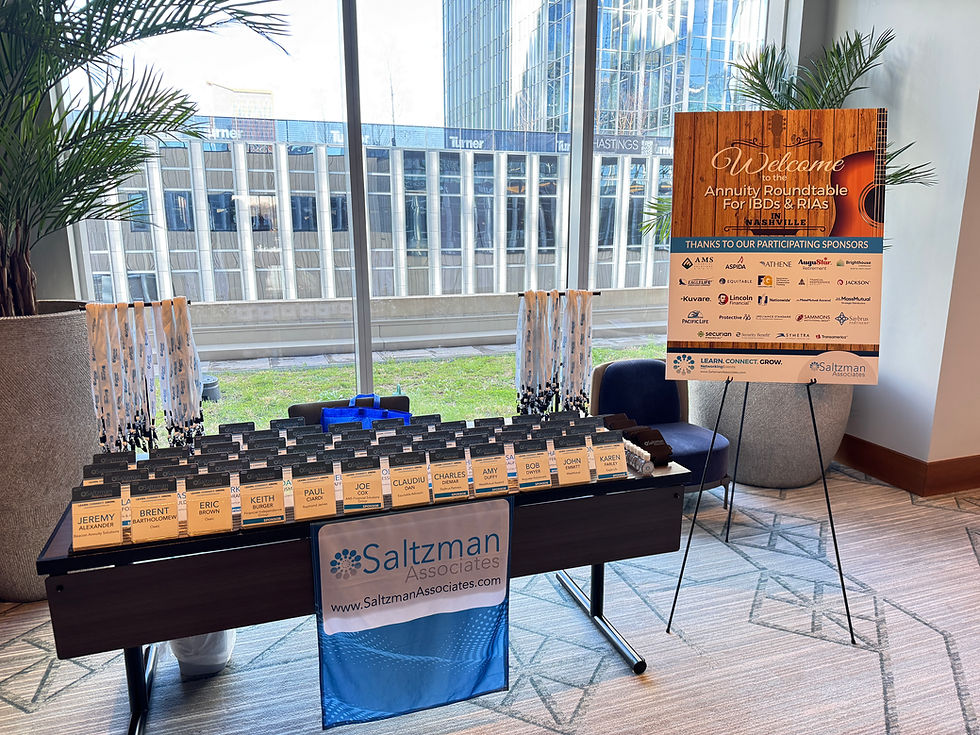
The 2026 Structured Products Roundtable brought together a thoughtful cross-section of industry participants for a candid and highly relevant discussion on where the market is headed, how firms are adapting, and what it will take to grow responsibly. Across sessions on product trends, technology, advisor adoption, and regulation, one theme came through clearly: the structured products space is evolving quickly, and the firms that combine innovation with discipline will be best positioned for what comes next. It was an energizing event to attend, not only because of the breadth of perspectives in the room, but because the conversations were practical, current, and directly connected to the real challenges firms are managing today.
Market Backdrop: Demand Is Shifting with Volatility and Investor Needs
The opening agenda topics aligned closely with what many firms are seeing across the industry: a market shaped by volatility, uncertainty, and growing demand for more customized, outcome-oriented strategies. That broader context set the tone for a productive discussion on where structured products fit today and how firms are positioning for 2026.
This backdrop came through clearly in the roundtable conversation around duration and underlyers. Participants noted that duration on single stocks and stock baskets has been moving lower amid market uncertainty, while duration on indices has been increasing as investors hedge geopolitical risk and volatility. The discussion also reflected a measured view on more complex underlyers, including high-volatility and QIS strategies. Several firms described limited organic advisor demand today, while others noted that interest is often being driven more by issuer marketing and platform conversations than direct client pull. The takeaway was balanced and practical: innovation continues, but simplicity, scalability, and advisor comprehension still matter.
What leaders are seeing in the market (and the growth moves that follow)
Many of the outlooks discussed are reinforced by Saltzman Associates’ benchmarking and the 2025 Annuity Market Year In Review, highlighting key industry trends. By examining distribution channels, leaders can spot shifts and focus on growth strategies that matter most—making benchmarking a guide to smarter decisions.
The best opportunities for firms arise during life events such as rollovers, job changes, and retirements. Teams are now using repeatable workflows to consistently capture these moments, moving beyond one-off efforts.
Product shelf management is now an ongoing process. Shelf decisions are increasingly treated as ongoing governance, not just “access.” Leaders talked about evaluating products through a wider lens: complexity, training time, supervision needs, operational friction, and—most importantly—the client outcomes each product is built to support. A steady review cadence (utilization, concentrations, complaints, service issues) helps keep growth aligned with risk controls.
Reinsurance in annuities remains vital but often misunderstood. Carrier strategy and capacity still matter, and reinsurance came up as an important (often misunderstood) part of how carriers manage risk and sustain product pricing over time.
SMA Momentum Is Real, but Infrastructure Remains the Gatekeeper
One of the most consistent themes throughout the meeting was interest in structured note SMAs. While adoption remains uneven, the direction of travel is becoming harder to ignore. Firms reported strong or growing interest, particularly as RIAs continue to request scalable advisory solutions. At the same time, many firms were candid that interest alone does not solve the operational challenge. Technology, due diligence, oversight, and platform readiness remain significant hurdles.
The discussion made an important distinction between believing in the investment concept and being ready to operationalize it. Some firms are still in the exploratory stage, while others are evaluating whether internal buildouts can ever justify the cost without meaningful sales volume. In contrast, firms that are further ahead are already using portfolio management systems to stay within risk parameters and are targeting both existing structured products users and adjacent advisor segments. The overall sentiment was encouraging: the opportunity is real, but firms will need the right infrastructure, governance, and economics before SMA adoption can scale in a meaningful way.
Managing the Business: Customization, Calendar Pressure, and Market Liquidity
The sessions on business management reinforced how operational complexity continues to define the structured products landscape. Calendar management remains a real challenge, particularly for firms navigating open architecture, a large menu of potential offerings, and the practical realities of Regulation Best Interest. The conversation reflected a tension many firms know well: broad choice can support flexibility, but it also raises questions around selection discipline, supervision, and consistency.
Day two underscored how significant custom issuance has become across the industry. Several firms described custom notes as representing a large and growing share of business, while others remain more calendar-driven but are actively working with partners to shift the mix over time. There was also a useful discussion on the tools supporting custom workflows. Platforms can help with pricing and requests for proposals, but participants were clear that complex structures still often require direct engagement with the issuer.
The secondary market discussion was equally candid. Participants recognized the value of improved liquidity and best execution, yet many also highlighted the practical limitations of today’s market structure. Research intensity, bid reliability, and uneven technology continue to make secondary activity more difficult than many would like. The result is a market where firms see opportunities for improvement but also understand why issuer repurchases still serve as the default path in many situations.
Technology and AI: High Potential, Careful Adoption
The technology discussion was one of the most timely parts of the roundtable. Firms are clearly experimenting with AI, but the level of adoption varies widely depending on use case, cost, and regulatory sensitivity. Some participants described AI being used to streamline RFQ workflows, support document generation, and improve internal monitoring. Others made clear that they are not yet ready to use AI in client-facing or sales-oriented processes, particularly where accuracy, disclosure, and supervisory scrutiny are paramount.
What made this conversation especially valuable was its honesty. Participants were not simply celebrating AI for its own sake; they were testing where it can add meaningful value and where it still falls short. Standardization emerged as a major enabler, with many in the room recognizing that cleaner documents, more consistent terminology, and better field-level data could unlock major efficiency gains. The energy in this session came from the sense that the industry is still early, but the path forward is becoming clearer: practical automation, stronger data quality, and disciplined use cases will matter far more than hype.
Advisor Growth Will Come from Education, Not Just More Product
The advisor and distribution session offered a grounded perspective on what sustainable growth really looks like. A recurring message was that participation alone is not the right metric; quality of adoption matters just as much as quantity. Firms discussed the importance of identifying the right advisor segments, supporting power users, and using education to expand engagement in a thoughtful way.
Several examples stood out. Some firms are leaning on internal conferences, peer-to-peer storytelling, and wholesaler support to broaden awareness. Others are using data more intentionally to show how structured products can improve the advisor and client experience, including account outcomes, client retention, and business growth. There was also strong support for making the advisor experience simpler, whether through education, better targeting, or SMA-based models that reduce complexity at the point of use.
Altogether, the session reinforced that the distribution strategy is becoming more sophisticated and that firms are increasingly focused on equipping advisors rather than just offering more inventory.
Risk and Regulation Remain Central to the Conversation
The final sessions made clear that risk management and regulatory readiness are not side topics; they are central to how firms are shaping the future of the business. Participants shared how they are refining disclosure practices, trade reviews, product restrictions, and advisor training in response to evolving expectations. Regulation Best Interest continues to frame many of these decisions, especially where complexity, concentration, and product suitability are concerned.
Just as important, the conversation showed that firms are learning from one another. Whether through updated risk acknowledgment forms, pre-trade reviews, annual compliance meetings, or more consistent disclosures, many participants are actively recalibrating their frameworks. The tone was serious but constructive. Rather than viewing regulation as an obstacle, the discussion often positioned it as a driver of better discipline, stronger investor protection, and more credible long-term growth for the structured products market.
Final Thoughts
This Structured Products Roundtable was both informative and encouraging. The agenda covered the right issues, and the discussion went well beyond theory to address what firms are actually experiencing in the market today. From SMA adoption and customization to AI, advisor engagement, and regulatory supervision, the event created space for practical dialogue, honest challenges, and forward-looking ideas.
Most of all, the roundtable reinforced that this is a market with real momentum. Firms are thinking carefully about how to scale, where to simplify, and how to grow with stronger controls and better client outcomes. That combination of realism and optimism made the event especially worthwhile to attend. It was a strong reminder that some of the most valuable industry conversations happen when experienced participants share what is working, what is not, and where the next opportunities may emerge.
Why the next roundtable is worth your time
For those who were not able to attend this year’s roundtable, future sessions will offer another valuable opportunity to join the conversation, hear how peers across the industry are approaching shared challenges, and take away practical ideas to apply right away. These events continue to provide meaningful perspective, strong dialogue, and actionable insights, and we would encourage anyone interested to join the next roundtable or one of our many other roundtable events.
Learn how peers are approaching product governance, advisor support, and supervision—so you can benchmark and pressure-test your program.
Connect with other industry leaders for candid conversations, shared lessons learned, and fresh perspectives.
Grow by leaving with a short list of practical next steps—workflows, service improvements, and controls you can act on.
If you’d like to learn more about the next event—timing, location, and how to participate—visit the Events page on our website.
IMPORTANT INFORMATION
The material herein has been provided to you for informational purposes only. This material is the property of Saltzman Associates, LLC, and may not be shared without the written permission of Saltzman Associates, LLC. No part of this material may be reproduced in any form or referred to in any other publication without the express written permission of Saltzman Associates. This material is provided for informational purposes only. The information contained herein has been obtained from sources believed to be reliable; however, Saltzman Associates, LLC does not guarantee accuracy or completeness.
© Saltzman Associates, LLC


Comments